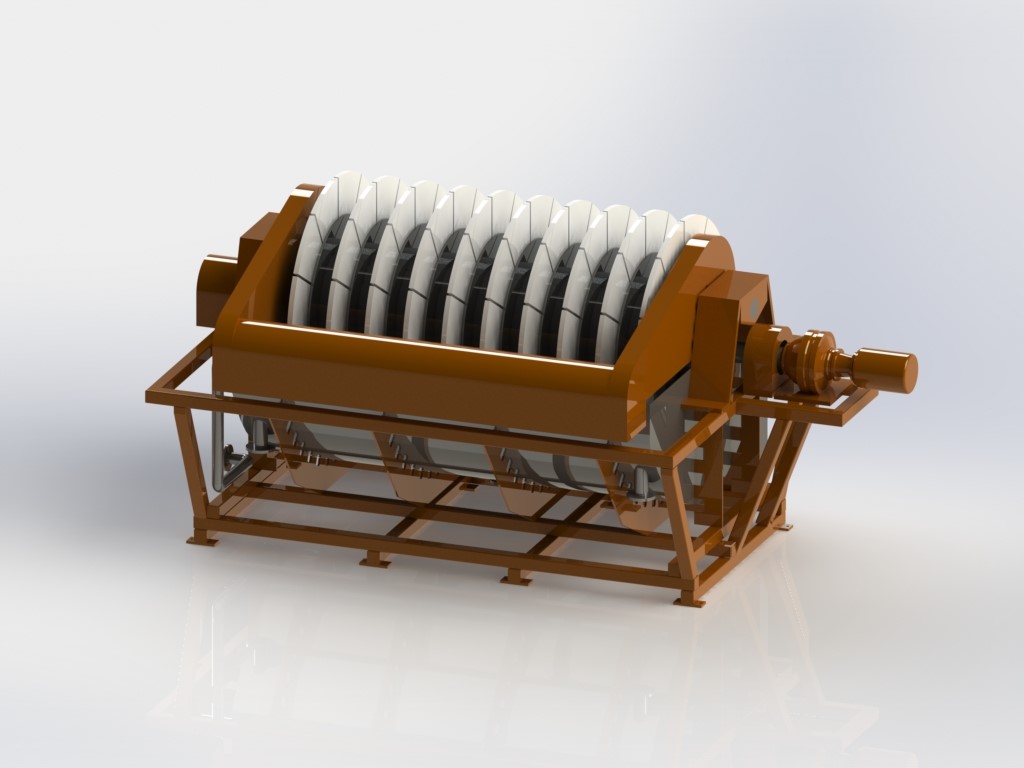
Introduction to Ceramic Filters
The ceramic filter is a dewatering device primarily composed of ceramic filter plates, a roller system, a stirring system, a feed and discharge system, a vacuum system, a filtrate discharge system, a scraping system, a backflushing system, a combined cleaning system (ultrasonic cleaning and automatic acid-dosing cleaning), a fully automated control system, a tank body, and a frame.
The ceramic filter operates based on the principle of capillary micro-pores. It employs microporous ceramic as the filtration medium, utilizing the numerous narrow micro-pores with capillary action to achieve solid-liquid separation. Under negative pressure conditions, the ceramic filter leverages the unique water-permeable yet air-impermeable characteristic of the microporous ceramic filter plates.creating a pressure differential between the interior and exterior of the ceramic filter plate. This draws air from the plate's cavity, causing suspended materials in the feed tank to adhere to the ceramic filter plate under negative pressure. Solids, unable to pass through the microporous ceramic filter plate, are retained on its surface. Meanwhile, liquids, driven by the pressure differential and aided by the hydrophilic nature of the ceramic filter plate, pass through smoothly. They then flow into the gas-liquid separation device for discharge or recycling, achieving the goal of solid-liquid separation.Under all conditions, the ceramic filter plate must not allow air permeation. This airtightness ensures low energy consumption and high vacuum levels during solid-liquid separation.
Ceramic filter plates, also known as ceramic filter membranes, ceramic discs, ceramic plates, or filter plates, are novel filtration media manufactured from corundum, silicon carbide, and other materials through specialized processes. As the core component of ceramic filter machines, these plates are extensively applied in the filtration and dewatering of mineral concentrates including iron concentrate, zinc concentrate, sulfur concentrate, copper concentrate, nickel concentrate, molybdenum concentrate, lead concentrate,tungsten concentrate, manganese concentrate, vanadium ore, aluminum concentrate, gold concentrate, non-metallic concentrates, and for solid-liquid separation in industries such as coal, fine chemicals, papermaking, pharmaceuticals, chemical fibers, food, and environmental protection.
When selecting ceramic filter plates as the filtration medium for ceramic filter machines, note the following:
- Match the material particle size and distribution with the micro-pores of the ceramic filter plate. Although larger pore sizes facilitate slurry absorption, they may cause clogging.
- Select ceramic filter plates with the same pore size but higher permeability, as higher permeability correlates with better slurry absorption.
Additionally, note that ceramic filter presses employ non-contact discharge. A smaller gap between the scraper blade and ceramic filter plate allows more filter cake to be scraped off per unit time, increasing production capacity. Therefore, adjust the scraper gap when conditions permit. Maintain a gap of approximately 1mm between the scraper blade and ceramic filter plate to prevent mechanical wear and extend the service life of the ceramic filter plate.